A trailing drawdown threshold follows your account’s highest point, not the starting balance. When you make money, the floor rises with you. When you give it back, the floor stays where it was. This asymmetry is why traders blow their evaluations on days that they finish profitable, and why paying attention to just the balance of your account won’t tell you anything about how much room you have left.
What it actually is
There are two types of drawdown limit: static and trailing. With static drawdown, the floor in your account sits at a specific distance below the starting balance and never moves. With trailing drawdown, the floor follows your high-water mark upward and never comes back down.
Trailing drawdown comes in two forms. End-of-day trailing measures the drawdown from your closing balance each trading session, while the intraday or live trailing drawdown measures from your highest point, including unrealized profit. The live trailing drawdown is particularly difficult, as a position that runs twelve points in your favor and comes back has already moved the floor, even though the trade closed at break-even, and your balance never changed. You have burned some of your trailing drawdown allowance, and it’s not coming back.
Work the numbers
Let’s take the previous example and put real money into it. Two ES contracts, twelve points, is $1,200. Run that situation through a $50,000 account with a $2,000 trailing threshold. The floor in this scenario starts at $48,000, and the trailing threshold is live.
Three versions of the same trade, on the same day, in the same market:
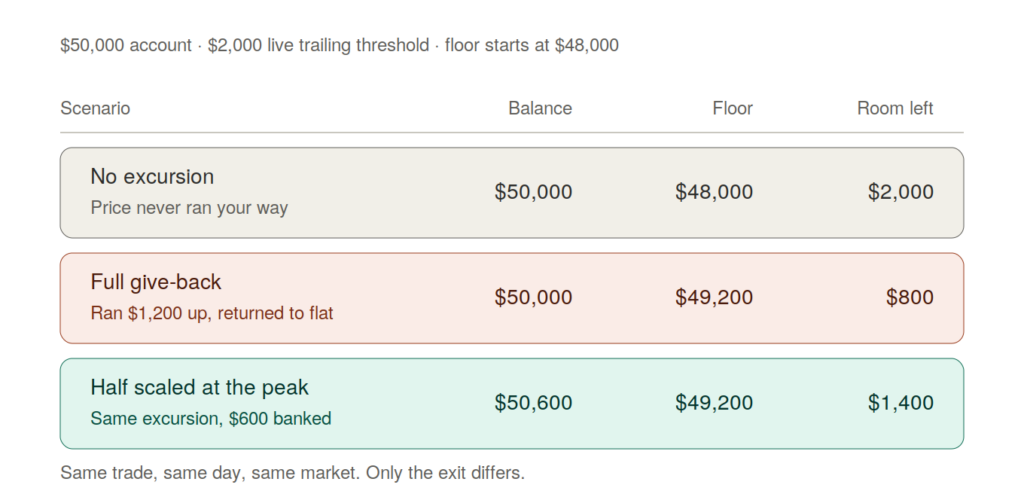
In the “full give-back” scenario, the trader did nothing wrong by any normal measure. The entry was right, the trade went their way, and they didn’t lose money. They are 60% closer to failing than when they started. You can fail an evaluation without ever having a losing day.
With end-of-day trailing drawdown, the result is completely different. The floor wouldn’t move in the “full give-back” scenario, because the account closed the session at $50,000, and this is the only number the rule looks at.
The same trade would cost you $1,200 of room under one rule and nothing under the other. Which rule governs your account is the first thing to establish before you place a single trade.
Why it punishes good trading
The biggest problem that a trader will face is when they let winners run. This is the correct way to trade and is how the real money gets made. However, under intraday trailing rules, it will also maximize the potential damage if you do not take some profit off the table along the way. This goes against how successful traders behave.
This means that when you are trading at a prop firm with an intraday trailing rule, a trader who scales out mechanically at every excursion will survive longer than a trader who holds the entire position, with the idea of capturing the entire move. The rule incentivizes behavior that isn’t optimal in a personal account.
The constraint here is that the rule doesn’t measure risk management; it measures how much unrealized profit you are willing to hold. Markets can be volatile, and it is common for a move to jump in your direction, only to turn things around.
A trader that has better entries and more patience can fail an evaluation that a mechanically worse trader passes. That is a feature of the rule, not a flaw in the traders themselves. Understanding this is the difference between adapting to the imposed constraint and taking it personally when the account dies – quite often leading to revenge trading and the dreaded “hamster wheel” of continuous evaluation attempts.
Where micros come in
Granularity is what makes scaling possible at all. This is where micro contracts are so important. For example, three contracts exit in thirds, while thirty micros exit in tenths.
Think about what this means with a single mini contract. If your account size says you should carry roughly 1.7 contracts’ worth of exposure, it’s impossible to scale one ES contract, with the only exit being all of it or none. The partial exit isn’t a discipline problem; the instrument doesn’t give you the option.
This is the difference between the second and third scenarios above, as they are the same trade and the same peak, with the same floor of $49,200. In one situation, the floor rose against the trader, but nothing came back with it. The other situation was a gain of $600 that was banked against the rise in the floor. The trader who took half off had thirty micros to work with in this situation. The trader who held one ES contract watched the same excursion and had no way to keep any of it.
The flexibility comes with a price. Ten micros cost roughly three times as much in fees as a mini contract does for the same exposure. If you are in a trailing threshold account, this premium buys something important: the ability to bank a portion of any excursion before it disappears. Whether or not it is worth paying that price will come down to how often your trades run and come back, but most traders have never actually looked.
What to actually do about it
- Understand which type of trailing drawdown you are operating under before the first trade takes place. The difference between live and end-of-day is significant and can change the way you must operate.
- Know exactly where your floor is currently, not where it started. Make sure to update the level every time it moves.
- Treat unrealized peaks as real for threshold purposes in live trailing drawdown accounts, even though they aren’t real for calculating balances.
- Construct a partial-exit rule in advance, not counting on calculating it in the heat of the moment. In the moment, with money on the screen, you will be hard-pressed to do the math.
- Know where or if trailing stops. It is common for a threshold to freeze once the account is up by the total drawdown limit, but not all do this.
The mistake
The most common mistake is checking your balance to see how much room you have left. The balance is on the screen, and it updates in real time. Because of this, it feels like the number that matters the most. However, this isn’t true.
The figure that matters the most as to whether or not the account survives is the gap between your high-water mark and your current equity. This number is rarely displayed on platforms, but if you have the ability to show it, this can help.
A trader can be up for the week, and even up for the month, positive for the day, and still be a few hundred dollars from failing. Balance doesn’t warn you about this, and it could look fine right up until the point you fail.
The question isn’t whether or not you are profitable; it is about how far you are from a number that only moves in one direction.