The Micro S&P 500, or MES contract, is one-tenth the size of the ES, the E-Mini S&P 500 contract. At just $5 per index point against the $50 per index point of the E-Mini S&P 500 contract, that means it’s $1.25 per tick against $12.50. It’s the same underlying index, it’s the same trading hours, and it has the same expiration cycle. The question here is: Which one of these contracts should you be trading, and when should you move up the risk chain?
The Specs
- Multiplier: $50 vs $5 per index point
- Tick size: 0.25 index points on both
- Tick value: $12.50 vs $1.25
- Symbols: ES and MES
- Contract months: March, June, September, and December on both
- Settlement: both settled in cash, no delivery
- Hours: almost 24-hour Globex session, Sunday evening through Friday afternoon, with a one-hour daily maintenance break
Most traders think of a position’s value as the margin put up to take it. The notional value matters more. For example, with the S&P 500 currently trading at 7,453.50, an ES contract controls 7,453.50 x $50 = $372,675 of index exposure. One MES contract controls 7,453.50 x $5 = $37,267.50 of index exposure. Examples provided are based on July 27, 2026, prices.
ES: cmegroup.com/markets/equities/sp/e-mini-sandp500.contractSpecs.html
MES: cmegroup.com/markets/equities/sp/micro-e-mini-sandp-500.contractSpecs.html
What it Means in Dollars
When trading an asset, it is easy to think of the “price per tick”, but this is meaningless if you do not understand how much it can move. At the time of writing, the average true range, based on the standard 14-day lookback, is about 90 index points.
What this means is that on a typical day you could see a move of about $4,500 for the ES, and $450 for the MES. Put another way: a four-point stop in ES is $200, while a four-point stop in MES is $20.
An adverse move of fifteen points against you is $750 in ES, while the same move is a loss of $75. This is the same move, the same chart; what changes is how this feels.
This is where things get personal. Trading at $12.50 a tick, a 15-point drawdown can cause some anxiety. You can feel the trade, and when you do – it can change how you behave. You might decide to take the trade off at breakeven because getting back to breakeven feels like relief. However, at $1.25 a tick, the same 15 points end up being noise, and you might have more ability to let the setup play out. Nothing has changed between the two trades, only the numbers, and more importantly, the potential for emotion to take over.
The Account Math
How much capital does one contract actually need?
Most traders size off margin. However, margin is the wrong input to use. The margin tells you what your broker will permit but says nothing about what your account can absorb. This is one of the most common mistakes futures traders make.
An example would be a trader who risks 1% per trade. Using a four-point stop, which is somewhat common for day traders, the math works out like this:
- One ES contract, with a four-point stop, has $200 at risk. This requires a $20,000 account.
- One MES contract, with a four-point stop, has $20 at risk. This requires a $2,000 account.
The trap is what happens when a broker’s day-trading margin makes an ES contract look affordable. However, the four-point stop above means that you are risking $200, or 10% of the account on a single trade if you choose to trade that contract. Five losses in a row, something that is entirely possible, halves the account. At that point, you have to double what is remaining just to get back to where you started.
This is where the MES comes into the picture. A four-point stop risks only $20, or 1% of the account. Five losses in a row are much more manageable, as traders will only be down $100, and this is realistic from a recovery standpoint.
There is a threshold where a move to ES makes sense, and it sits in the $20,000-$25,000 region. Below that, you can’t use a realistic stop without taking outsized risk. It doesn’t matter what the margin allows; it is your job as a trader to protect your account, and this is what MES allows you to do in a much more granular manner.
Costs
Commissions don’t scale with contract size. There are exchange fees, clearing, and NFA, each of which is charged on every contract. These fees are not charged per dollar of exposure, but per contract. Exchange and clearing fees are lower on MES, but nowhere near one-tenth. Ten micro contracts will still cost several times more than one ES contract here.
There is also the NFA regulatory fee, which adds $0.02 for each contract. There are also broker commissions to think of, which can vary from place to place. The following figures are listed at Discount Trading, a well-known discount broker.
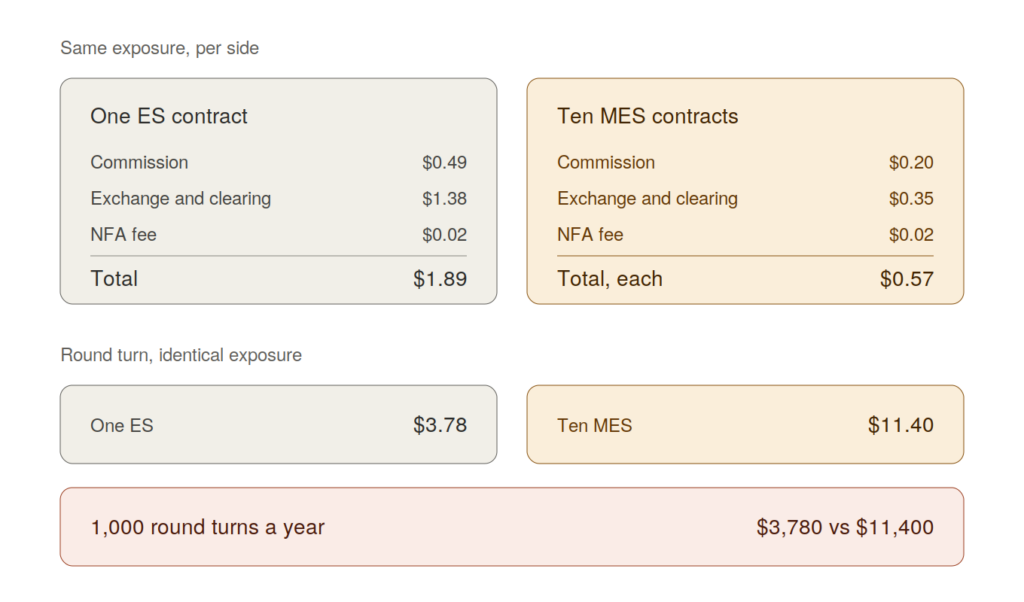
The comparison between ten MES contracts and one ES is stark, despite being the same exposure to the market. One ES round turn costs $3.78 in this example, while ten MES round turns cost $11.40. This is the same position, the same risk, but at three times the cost. You pay $7.62 extra on every round turn for the privilege.
Four round turns a day over 250 sessions a year is 1,000 completed round-turn trades. This would mean fees of $3,780 in the ES against $11,400 in MES. This is over $7,600 a year, paid by you just for the ability to slice the same exposure into ten smaller pieces instead of one.
The spread doesn’t change this, as ten MES contracts crossing a tick costs $12.50, exactly the same as the ES contract doing the same. The spread will scale proportionally, so it’s neutral in this equation. The per-contract fees are the entire story here.
Liquidity and Execution
Does it fill the same?
The reality is that both of these contracts are some of the most liquid contracts available. MES is genuinely fine for retail traders, so for most people, the liquidity will not be an issue. Both contracts quote in the same 0.25 tick, and the spread as a proportion of exposure is identical. The difference is found in the depth at the touch.
A large order in MES, 20 or 30 lots, can move the order book in ways that 2 or 3 in the ES won’t. It’s a bit ironic, but a trader that is stacking micros to simulate a mini contract is more likely to feel it.
During the New York open and around scheduled economic releases, the order book in both contracts thins. Spreads can widen beyond the typical one tick, and stops can fill further from the trigger point than they normally would. This is exactly when the depth difference matters the most, as stacked micro positions can walk a thin book further than the equivalent mini does, and it happens at the moment you can least afford it.
When to Step Up
A big question for any trader is when it is time to step up from micros to mini contracts. The standard answer is, “When you feel ready”, and it’s useless. The answer must be found in the math, not from how last week went.
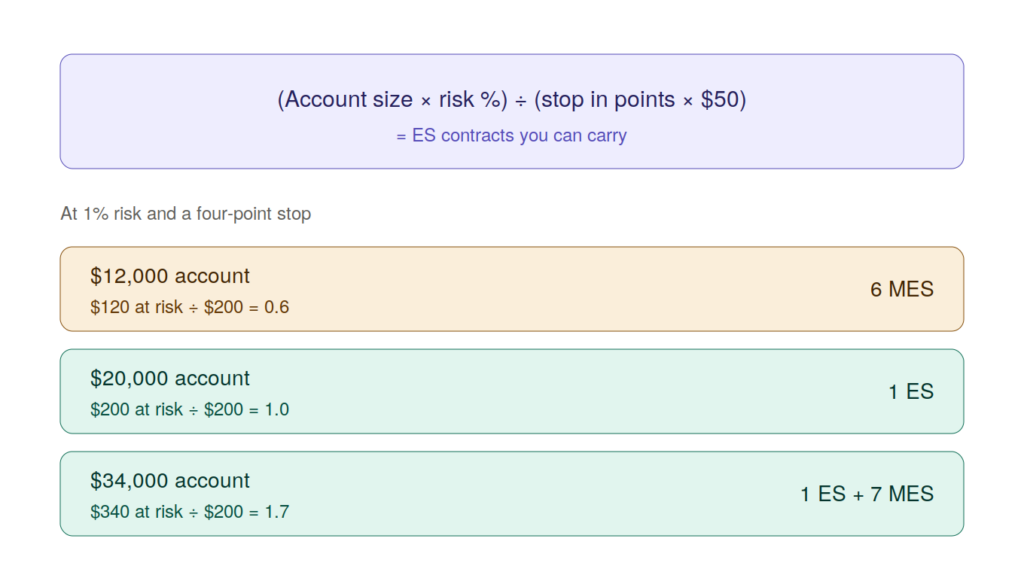
A ten-point stop puts $500 at risk, so one ES needs a $50,000 account.
The math is necessary but isn’t sufficient. There are other factors, like a significant sample of trades, to determine whether or not it makes sense to take on more risk. Once both the math and the results line up, you can explore expanding your position size.
Five MES contracts is a genuine half-size position. Seven MES contracts will be a 70% sized position. You cannot express that in ES, as the smallest step is from one contract to two, doubling your exposure. With the ability to use something like a hybrid model, you give yourself more granular control and the ability to keep your risk controlled. Buying 17 MES contracts, or one ES contract and 7 MES contracts, gives traders flexibility to protect themselves and deal with the volatility of markets.
Prop Firm Evaluations
How does this change inside a funded account?
Most prop firm accounts are sized and limited in micro-equivalents, with many of them counting one mini against your limit of exposure the same as 10 micros. Trailing drawdown changes the value of granularity entirely. In a personal account, size affects returns. However, in an evaluation or funded account with a trailing drawdown threshold, the ability to take partial size and scale out precisely affects whether or not the account survives, as the drawdown ratchets up against your high-water mark, either live or end-of-day. A position that runs up and then gives the profit back raises your threshold permanently without you keeping the gains. Scaling out near the peak means the threshold rise is matched with realized gains.
A $50,000 account with a $2,000 trailing threshold runs $1,200 into profit, then gives it all back — the threshold has moved up $1,200, and you’re now $1,200 closer to failing with nothing in hand. Scale half out at the peak and $600 is realized, so the threshold rise is half covered.
Many prop firms will require micros at lower balances by rule, so the choice isn’t yours early on. The question becomes whether you should move up, not just whether you’re allowed to.
The Mistake
What do people get wrong about this?
The trader who decides to size down to micro contracts and then puts on ten of them is making a mistake. Nothing changes except the fee load. This is an easy trap to fall into, and doing the math before putting the position on can help you decide what exposure to use.
Micro contracts increase granularity, but they don’t reduce risk. Ten MES contracts give you one ES contract of exposure, but with worse economics. What micros actually buy you is the ability to risk the appropriate amount your account math produced, instead of rounding to the nearest whole contract.
The question about whether to trade ES or MES was never about which was safer; it was about whether or not your account is able to carry the risk of the larger contract, the smaller contract, or somewhere between the two.